

Welcome to the Student Success Initiative — a campus-wide effort to help every student thrive at the University of Michigan. We bring people, ideas, and resources together to create a more connected, empowering student experience. Explore how we make an impact and discover our latest projects.

The Academic Advising/Coaching Team (AACT), a project team affiliated with the U-M Student Success Initiative, was charged with developing a shared framework for undergraduate academic advising/coaching services and drafting a report with action-oriented recommendations and resources needed to improve all aspects of the advising experience. This project was motivated by U-M’s commitment to supporting the undergraduate student experience and promoting a campus-wide approach to and standard for promoting student success. Advising-related recommendations included in the Initiative Planning Group on Student Academic Success’s report to the Provost also helped shape the work of this project team.
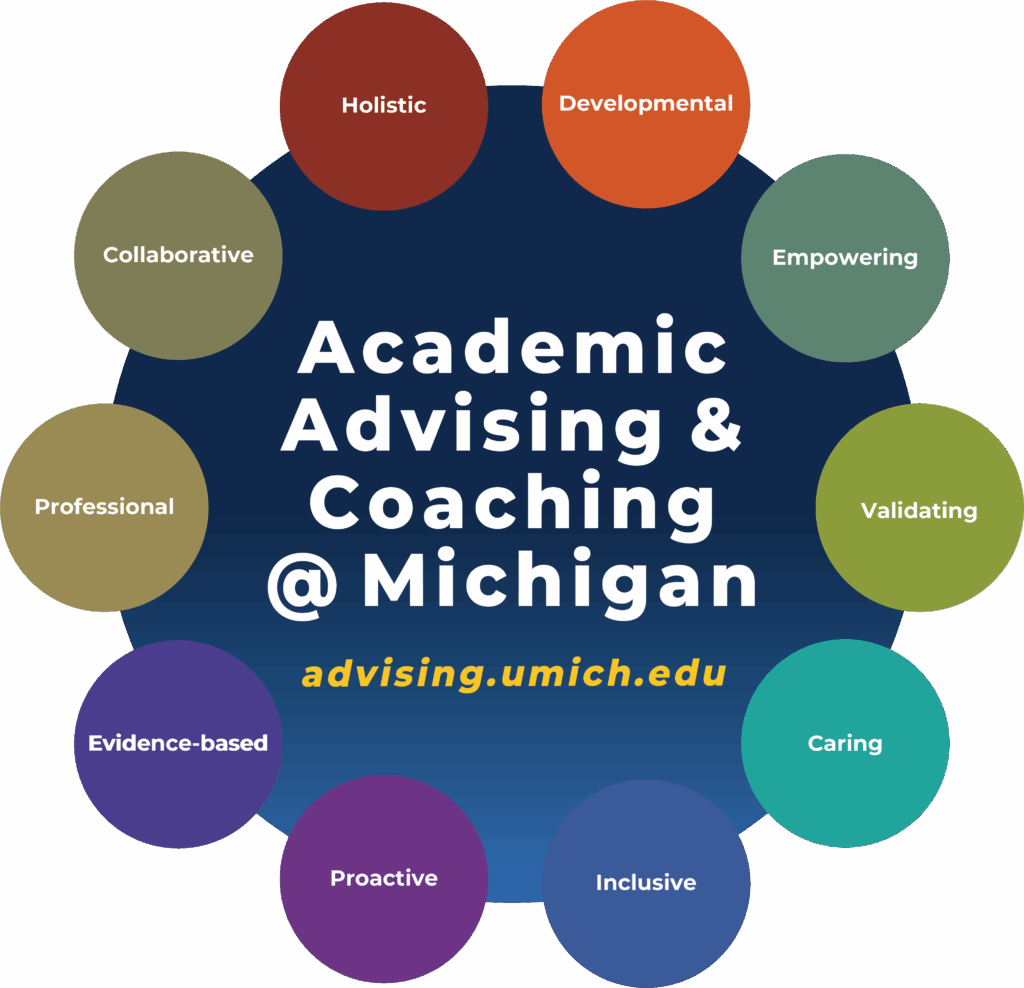
Advising Council at U-M, Office of the Provost, Undergraduate Education, Michigan Athletics, Office of Academic Multicultural Initiatives (OAMI), Center for Research on Learning & Teaching (CRLT), Student Accessibility and Accommodation Services, and all undergraduate schools/colleges
As an evidence-based and nationally recognized strategy for student academic success, early momentum (EM) encourages students to complete a full course load for fall, winter, and in some cases, spring/summer terms. In general, a total of at least 30 credits achieved by the end of the first year.
Center for Academic Innovation, Office of the Provost, Undergraduate Education, ASSET (Analytics for Student Success and Equity Transformation), Institutional Research with the Office of Budgets and Planning, and many Schools, Colleges, and department leaders
In Winter 2025, the University launched the first phase of the U-M Student Success Initiative, which corresponded with the kick-off of the Career Student Success Project. Participants in the Career Student Success Project were invited to consider a vision for career services student success and specific opportunities (as informed by that vision) geared to improve student success. The group was tasked with identifying 3-4 of the most important, urgent, and actionable opportunities and then developing a deeper vision for the opportunities identified. Finally, the committee was asked to develop action items for each opportunity, with the compilation of the vision and action items to be presented to institutional leadership in August of 2025.
University Career Center, College of Literature, Science, and the Arts, College of Engineering, Rackham, U-M Dearborn Career Services, Taubman College, School of Information, School of Music, Theater, and Dance, School of Education, Kinesiology, School of Public Health, School of Environment and Sustainability, LSA Opportunity Hub, U-M Alumni Association, Ford School of Public Policy, Michigan Athletics, School of Social Work
The STEM Success Project Team was convened in November 2024 in order to explore the current landscape of programs that support students in STEM fields, particularly those in underrepresented and underserved groups, from pre-college programs and summer enrichment opportunities through the undergraduate experience.
The STEM Success project team identified 7 core areas that can improve support for underrepresented and underserved students in STEM fields. The core areas include:
College of Engineering, LSA Science Learning Center, Center for Educational Outreach, Center for Research on Learning & Teaching (CRLT), National Center for Institutional Diversity, Office of Academic Multicultural Initiatives (OAMI), Women in Science & Engineering, M-STEM Academics, Comprehensive Studies Program, Office of Student Life
The Time Away and Emergency Finding team was charged to develop an understanding of the current landscape of emergency funding, including the CEW+ graduation grants pilot, explore how U-M engages with students before, during, and after a leave, and identify recommendations for new processes and improvements for supporting students during unexpected crises or leaves of absence.
Center for the Education of Women+, Dean of Students, Student Life, Office of Financial Aid, College of Engineering, International Center, Rackham, Wolverine Wellness
The Transfer Student Success Project Team is dedicated to enhancing every aspect of the transfer student experience at the University of Michigan, from recruitment through graduation, both inside and outside the classroom. Our aspiration is to become a truly “transfer-friendly” campus, which will require a significant shift in how we engage students and in how we collaborate among campus units, improving communication, strategies, and systems.
The Transfer Student Success Project Team will meet regularly during the 2025-26 academic year to do a landscape analysis of the current U-M transfer student experience, identify gaps and areas for improvement, benchmark best practices at peer institutions, and draft a report with recommendations for the Vice Provost for Undergraduate Education.
Student success is always evolving. Don’t miss out — get resources and insights delivered to stay informed.
Receive our Newsletter